
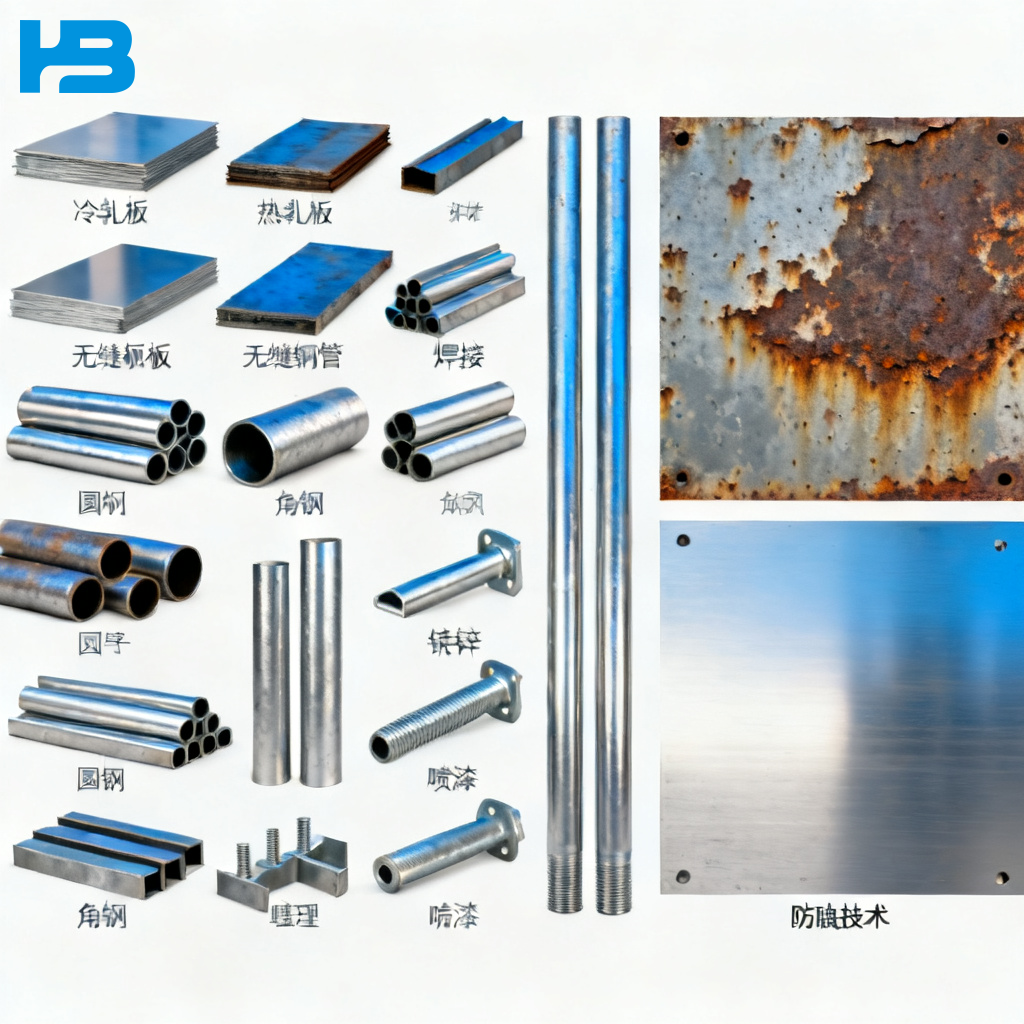
Steel Classification
1) Plates: Plates include cold-rolled steel plates and hot-rolled steel plates. Marked as δ×B×L (thickness×width×length).
2) Pipes: Pipes include seamless steel pipes and welded steel pipes. Marked as D×δ×L (outer diameter×thickness×length).
3) Profiles: Includes simple cross-section steel sections (round steel, square steel, angle steel) and complex cross-section steel sections (channel steel, I-beams).
4) Wire Rods: Classified by cross-section (round and elliptical), by size (thick and thin), and by composition (low, medium, and high carbon steel).
Rusting of steel refers to the damage caused by a chemical reaction between its surface and the surrounding environment. Rusting can occur in many corrosive media, such as humid air, soil, and industrial exhaust gases. Increased temperature accelerates the chemical reaction, thus accelerating the rate of rusting.
Severe corrosion of steel during storage not only reduces its cross-sectional area and lowers its material quality, even rendering it unusable, but also requires significant time and effort for rust removal. Rust removal during use not only reduces the stress-bearing area but also creates stress concentration due to localized rust pits, accelerating structural failure. Especially when the structure is subjected to repeated loads, the steel will experience corrosion fatigue, significantly reducing its fatigue strength and leading to brittle fracture.
1. Classification of Rust Based on the Different Effects of Steel Surface on the Surrounding Medium
1) Chemical Corrosion
Chemical corrosion is a purely chemical corrosion caused by the chemical reaction between steel and electrolyte solutions or various dry gases (such as O2, CO2, SO2, etc.) in the environment. No electric current is involved in the corrosion process. This type of corrosion is mostly oxidation, forming loose oxides on the steel surface. This corrosion is greatly affected by the environment; it progresses slowly in dry environments, but rapidly in environments with high temperature and humidity.
2) Electrochemical Corrosion
Electrochemical corrosion occurs when steel comes into contact with an electrolyte solution, generating an electric current and forming a galvanic cell. Due to the difference in electrode potentials between the different components of the steel, two electrodes easily form. For example, when steel comes into contact with humid air, water, or soil, a film of water forms on the surface. This water contains various ions dissolved from the air, thus forming an electrolyte. Through a series of physical and chemical reactions, the ferrite in the steel is oxidized to ferric hydroxide and ferric oxide, resulting in corrosion.
In practical engineering, the corrosion that occurs is primarily electrochemical corrosion.
2. Protection against steel corrosion
In practical engineering, there are three main methods for protecting steel from corrosion.
1) Protective Film Method
This method uses a protective film to isolate steel from the surrounding environment, thereby preventing or slowing down the destructive effects of external corrosive media on the steel. Examples include spraying paint, enamel, or plastic onto the steel surface; or using a metal plating as a protective film, such as zinc, tin, or chromium.
2) Electrochemical Protection Methods
Based on the specific cause of corrosion, this method is divided into non-current protection and impressed current protection.
Non-current protection, also known as sacrificial anode protection, involves attaching a more reactive metal, such as zinc or magnesium, to the steel structure. Because zinc and magnesium have a lower potential than steel, they become the anode of the corrosion cell and are destroyed (sacrificial anode), while the steel structure is protected. This method is often used in areas where it is difficult or impossible to cover with a protective layer, such as steam boilers, ship hulls, underground pipelines, port structures, and road and bridge construction.
3) Alloying
Adding alloying elements such as nickel, chromium, titanium, and copper to carbon steel enhances its corrosion resistance, creating different alloy steels.
While the above methods can be used to prevent corrosion of reinforcing steel in reinforced concrete, the most economical and effective approach is to increase the density and alkalinity of the concrete and ensure sufficient protective layer thickness for the reinforcing steel.
In cement hydration products, approximately 1/5 calcium hydroxide is present, resulting in a pH of around 13. The presence of calcium hydroxide creates a passivation film on the surface of the reinforcing steel, forming a protective layer. However, calcium hydroxide can also react with atmospheric CO2, reducing the alkalinity of the concrete. This can damage the passivation film, activating the steel surface. In humid environments, electrochemical corrosion begins on the steel surface, leading to longitudinal cracking of the concrete. Therefore, increasing the density of the concrete improves its resistance to carbonation.
Furthermore, chloride ions (Cl) can damage the passivation film; therefore, the amount of chloride salts used should be limited when preparing reinforced concrete.
Impressed current protection involves placing scrap steel or other refractory metals, such as high-silicon ferroalloys and lead-silver alloys, near the steel structure. The negative terminal of an external DC power supply is connected to the steel structure being protected, and the positive terminal is connected to the refractory metal. When current is applied, the refractory metal becomes the anode and is corroded, while the steel structure becomes the cathode and is protected.
3. Rust Removal from Steel
When steel rusts, its volume increases, causing the reinforcing steel in reinforced concrete to expand and crack.
Currently, there are generally three methods for rust removal.
1) Wire Brush Rust Removal
Rust on the steel surface can be removed manually using a wire or semi-automatic wire brush until the metal surface is exposed. This method is inefficient and the quality of rust removal cannot be guaranteed.
2) Acid Pickling for Rust Removal
The rusted steel is placed in an acid pickling tank to remove oil and rust until the entire surface of the component is iron-gray. The surface is then thoroughly cleaned, ensuring no residual acid remains. This method is more thorough, efficient, and effective than manual rust removal.
3) Sandblasting for rust removal
The rust on the surface of the steel is removed using a sandblasting machine until the surface of the component is grayish-white, and there should be no yellow residue. This method is a relatively advanced rust removal method.
Rust prevention measures for reinforced concrete mainly involve considering the quality requirements of the concrete based on the nature of the structure and the environmental conditions, namely limiting the water-cement ratio and the amount of cement, and strengthening construction and management to ensure the compactness of the concrete and sufficient protective layer thickness, and limiting the amount of chloride admixtures.
Prestressed steel reinforcement generally has a high carbon content and is often processed by deformation or cold drawing, making it more susceptible to corrosion damage, especially high-strength heat-treated steel bars, which are prone to stress corrosion. Therefore, important prestressed load-bearing components must undergo strict inspection of raw materials, in addition to prohibiting the use of chloride salts. Rust removal measures for reinforcement also include the use of rust removers (such as dichromates).
Can't find what you're looking for ?
Leave a Message we will call you back quickly!
Product Classification
Professional Service
Interested? Leave your contact details.
Search Starts Here