
I. Material Characteristics: The Perfect Fusion of Dual Metals
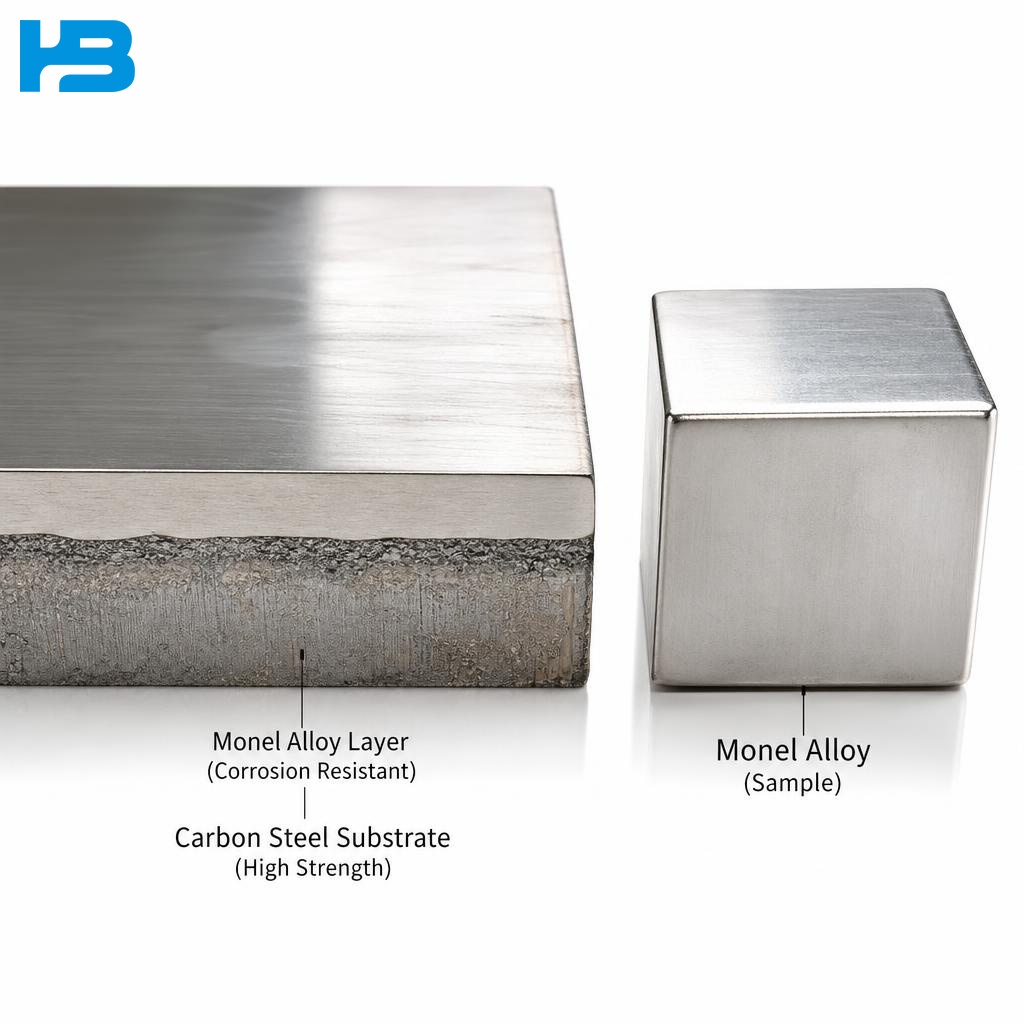
Monel-clad steel plates utilize explosive welding or vacuum roll-bonding processes to achieve an atomic-level metallurgical bond between a high-grade Monel alloy (Monel 400/500) cladding layer and a high-strength carbon steel or low-alloy steel base plate. This structural configuration perfectly integrates the core advantages of both materials:
Cladding Layer (Monel Alloy): Inheriting the superior corrosion resistance characteristic of nickel-copper alloys, it demonstrates exceptional stability in environments containing hydrofluoric acid, seawater, high concentrations of chloride ions, alkaline solutions, and various reducing acid media. Its corrosion rate is significantly lower than that of traditional stainless steels, making it one of the few critical materials capable of withstanding hydrofluoric acid.
Base Plate (Structural Steel): Provides excellent mechanical strength, rigidity, and weldability, thereby meeting the structural load-bearing and high-pressure operational requirements of pressure vessels and large-scale industrial equipment.
Core Value: Compared to solid Monel alloy plates, Monel-clad steel plates enable a 65% to 80% reduction in the consumption of the precious metal nickel, thereby substantially lowering material costs while achieving a synergistic performance where the combined result is greater than the sum of its parts.
II. Technological Breakthroughs: Accelerated Localization and the Filling of Gaps in the High-End Market
For a long time, high-quality Monel-clad plates were dependent on imports—characterized by exorbitant prices and lengthy lead times. As of 2026, however, several leading Chinese new materials enterprises have successfully achieved stable mass production of high-quality Monel-alloy clad steel plates through intensive technological breakthroughs. The performance of these products now fully meets international certification standards, including those of ASTM, ASME, and various classification societies.
The mature application of vacuum rolling cladding technology—compared to traditional explosive welding—offers a more eco-friendly production process, superior plate flatness, and greater internal quality stability. This advancement has effectively resolved critical industry pain points associated with traditional methods, such as limitations on plate dimensions and inconsistent bonding rates.
Domestically produced Monel-clad plates have achieved a qualitative leap in key performance metrics—including the uniformity of the corrosion-resistant layer, interfacial bonding strength, and non-destructive testing pass rates—thereby successfully gaining entry into high-end application sectors such as nuclear power and deep-sea oil and gas exploration.
This localization of production has driven product prices down by 30% to 40% compared to imported equivalents, while simultaneously shortening delivery lead times by over 50%. These factors have significantly accelerated the widespread adoption of this material within both domestic and global markets.
III. Market Drivers: Surging Demand Across Three Key Sectors Fuels Growth
Currently, market growth for Monel-clad steel plates is primarily driven by the following three high-growth industries:
Chemical and Petrochemical Industries (Fluorochemicals, Alkylation Units)
In highly corrosive environments—such as those involving hydrofluoric acid, sulfuric acid, or high-concentration brine—Monel-clad plates serve as the "last line of defense" for ensuring the safe and long-term operation of equipment. Driven by the global trend toward larger-scale chemical plants and the advancement of CCUS (Carbon Capture, Utilization, and Storage) projects, demand for this material in critical towers, heat exchangers, and storage tanks has seen a year-on-year growth of 40%.
Marine Engineering and Shipbuilding
In the face of long-term corrosion from seawater, salt spray, and marine atmospheres, Monel-clad plates are widely utilized in components such as seawater desalination equipment, marine pumps and valves, and offshore platform heat exchangers. With a corrosion rate of less than 0.002 mm per year in a 3.5% NaCl solution, the material offers lifecycle maintenance costs significantly lower than those of conventional materials.
Clean Energy and Nuclear Power
Auxiliary systems in nuclear power plants, geothermal well equipment, and hydrogen storage and transport facilities impose stringent requirements on material properties—specifically regarding corrosion resistance, low magnetism, and high-temperature endurance. Thanks to their exceptional overall performance, Monel-clad steel plates have become the preferred choice for the lightweight and high-reliability design of new energy equipment.
IV. Industry Trends: High Performance, Customization, and Green Initiatives
Looking ahead to the 2026–2030 period,
the Monel-clad steel plate industry is poised to exhibit three core trends:
Market demand is shifting from standard plates toward customized products—specifically wide-format, ultra-thick, and special-grade materials (such as Monel K-500)—to meet the requirements of extreme operating environments, such as deep-sea exploration and nuclear power generation.
The widespread adoption of advanced technologies—including vacuum rolling and digital twin systems—will significantly reduce energy consumption and material waste, thereby driving the industry's transition toward low-carbon, high-efficiency, and intelligent manufacturing.
Leveraging their superior cost-effectiveness and reliable supply capabilities, Monel-clad steel plates produced in China are rapidly displacing products from Europe and the Americas; with export orders continuing to surge, these materials are securing a prominent position within the global market for high-end corrosion-resistant materials.
Can't find what you're looking for ?
Leave a Message we will call you back quickly!
Product Classification
Professional Service
Interested? Leave your contact details.
Search Starts Here