
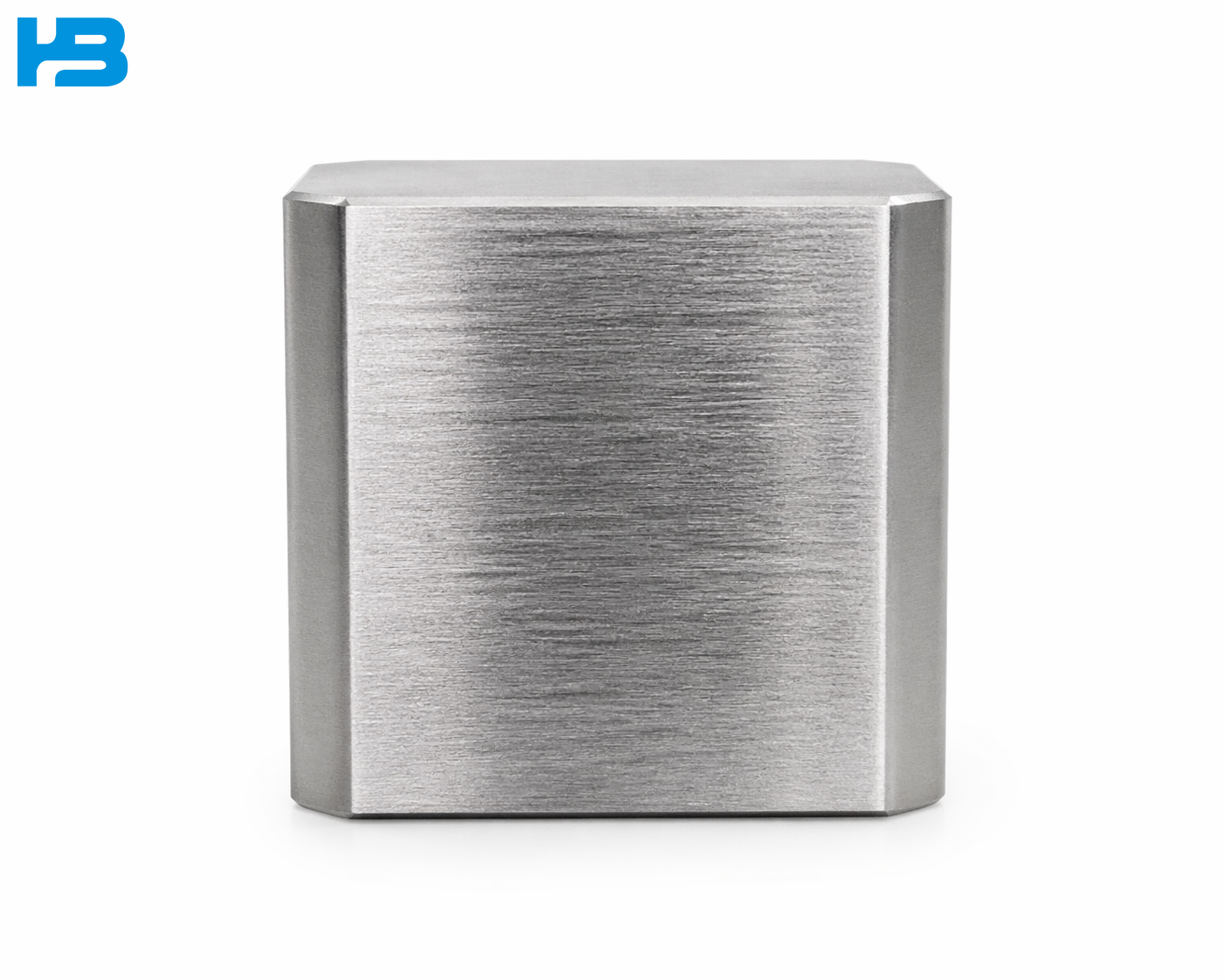
Wrought Nickel
Pure nickel UNS N02200 is utilized in the chemical industry due to its corrosion resistance—particularly against alkalis. It also possesses properties suitable for electromagnetic interference shielding and sensor applications.
Nickel-iron alloy
These materials serve as soft magnetic materials, glass-to-metal seals, and materials exhibiting specific thermal expansion characteristics.
Invar® (UNS K93600)—composed of 36% nickel and the remainder iron—is distinguished by a near-zero coefficient of thermal expansion at room temperature. This makes it invaluable in applications requiring high dimensional stability, such as precision measuring instruments and thermostat rods. Furthermore, due to its extremely low rate of thermal expansion, it is also suitable for use in cryogenic environments.
Alloys containing 72–83% nickel exhibit optimal soft magnetic properties and are utilized in transformers, inductors, magnetic amplifiers, magnetic shielding, and memory storage devices.
Nickel-copper alloy
They possess strong resistance to corrosion by alkaline solutions, non-oxidizing salts, and seawater. The most well-known is Alloy 400.
Nickel Molybdenum Alloy
In the absence of oxidizing ions—such as iron, copper, or dissolved oxygen—they exhibit strong resistance to reducing acids. The most notable example is Alloy B-2.
Nichrome
These alloys are characterized by strong corrosion resistance (including resistance to scaling) at both ambient and elevated temperatures, good high-temperature strength, and high electrical resistivity. The alloys are primarily classified into three categories:
High-resistance nickel-chromium (and nickel-chromium-iron) alloys for heating elements, such as 70-30 (UNS N06008) and Grade C (UNS N06004).
Nickel-chromium alloys (containing iron and other alloying elements) with excellent corrosion resistance. The most well-known are Alloy 600 (UNS N06600) and Alloy 601 (UNS N06601).
Ni-Cr alloys (containing iron and other alloying elements) possess good corrosion resistance.
Nickel-chromium alloys possessing high-temperature strength and creep resistance are, for the most part, age-hardenable—such as Alloy X-750 (UNS N07750).
Nickel-Chromium-Iron Alloy
Alloys are basically divided into two categories:
Nickel-Chromium-Iron Alloy
Nickel-chromium-iron alloys exhibit excellent strength and resistance to oxidation, carburization, and other types of high-temperature corrosion at high temperatures. The most well-known are Alloy 800 (UNS N08800) and its variants 800H (UNS N08810) and 800HT (UNS N08811). (Recently, these alloys have been classified as stainless steel to reflect their higher iron content.)
Nickel-chromium-iron alloys (containing molybdenum and copper) exhibit outstanding corrosion resistance in specific applications. Perhaps the most well-known is Alloy 825 (UNS N08825), which possesses excellent resistance to sulfuric acid. Alloy G-3 (UNS N06985) demonstrates superior corrosion resistance to commercial phosphoric acid, as well as to many complex solutions containing highly oxidizing acids.
Nickel-Chromium-Molybdenum Alloy
These materials possess strong corrosion resistance, with Alloy C-276 (N10276) being the most renowned among them. They exhibit exceptional resistance to reducing acids, such as hydrochloric acid and sulfuric acid. Building upon this composition, numerous variants have been developed—modifying the chromium and molybdenum content, and in some cases incorporating copper or tungsten—to enhance corrosion resistance under more strongly oxidizing or reducing conditions. These include Alloy C-22 (N06022), Alloy 59 (N08059), Alloy C-2000 (UNS N06200), and Alloy 686 (N06686).
Nickel-Chromium-Cobalt Alloy
The addition of cobalt and molybdenum imparts solid-solution strengthening and high creep-rupture strength to Alloy 617 (UNS N06617). The cobalt added to HR-160 (N12160) provides excellent resistance to various forms of high-temperature corrosion—such as sulfidation and chloride attack—in both reducing and oxidizing environments.
Nickel-titanium alloy
55% Nickel-Titanium alloy (UNS N01555)—also known as Nitinol—exhibits shape memory characteristics. When formed at a specific temperature and subsequently deformed at a lower temperature, it reverts to its original shape upon reheating. The transition temperature can be precisely tuned through careful control of the alloy's composition. Medical devices and specialized connectors represent two specific applications that utilize this property. This same alloy is also capable of withstanding substantial elastic deformation while still recovering its original form (a characteristic known as superelasticity). This property has found widespread application in fields such as eyeglass frames and shock absorbers designed to provide seismic resistance for historic stone structures.
Can't find what you're looking for ?
Leave a Message we will call you back quickly!
Product Classification
Professional Service
Interested? Leave your contact details.
Search Starts Here